
Criminal Court Cases in Mitchell County
Mitchell County court cases split by offense level. The 32nd Judicial District Court hears felony matters, and the District Clerk keeps those criminal filings in Room 302 of the Mitchell County Courthouse. Class A and Class B misdemeanor records ordinarily sit in the county-level court structure through the County Clerk in Room 103. Fine-only Class C charges and city ordinance matters remain with the municipal or justice court that handled the citation. A citation or capias in one of those courts does not become part of the district felony file merely because it arose in Mitchell County.
The court file begins after a prosecutor files a complaint, information, or indictment. It can show a charge that differs from the offense entered at jail intake. For the separate intake trail, use the Mitchell County arrest search process. The case record is the stronger source for arraignment, pleas, motions, disposition, judgment, and sentence.
The official District Clerk page shows the local felony-record counter. The image below preserves that public contact route.
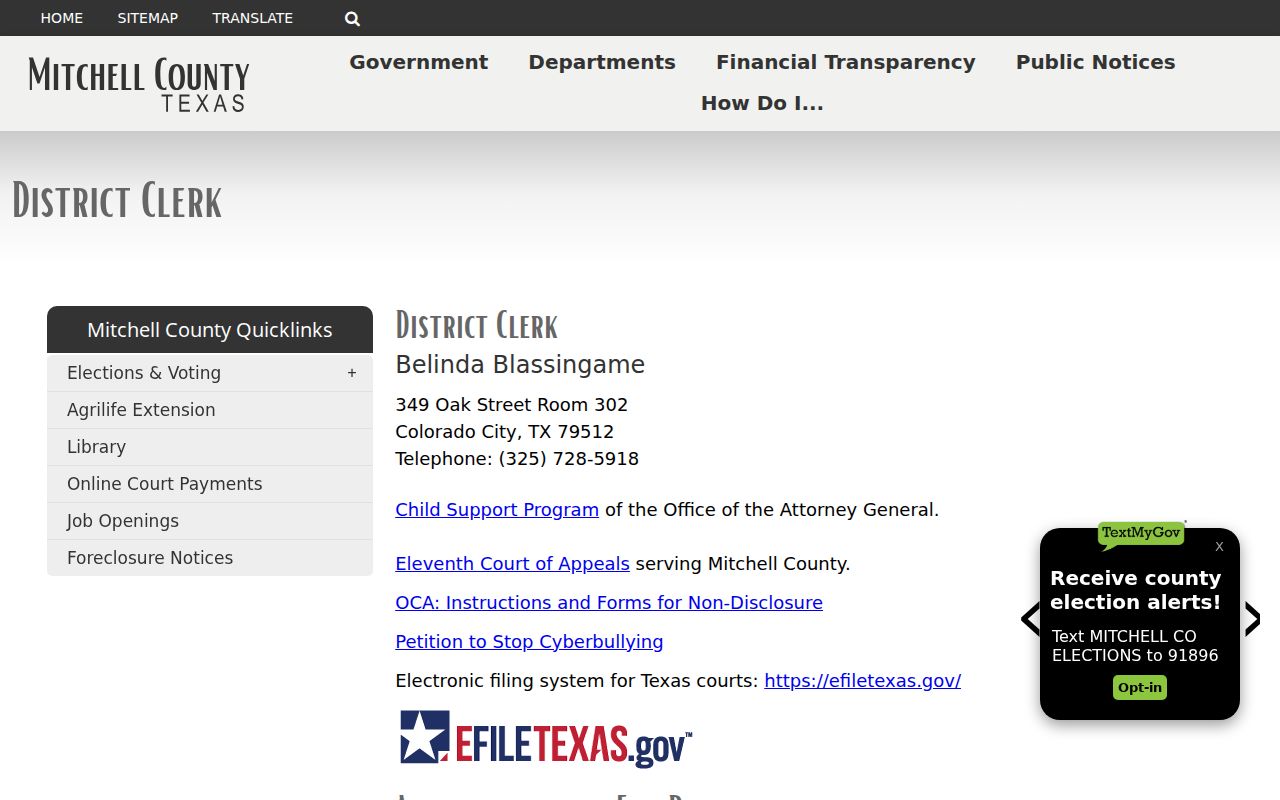
Room 302, rather than a general web index, is where a Mitchell County felony docket can be confirmed against the clerk's source file.
Mitchell County Courts by Charge
Start with the alleged offense class, not the place of arrest. Texas Penal Code Chapter 12 places felonies in district court and Class A or B misdemeanors at the county level. Class C cases are fine-only unless the offense statute says otherwise, so municipal and justice courts handle those matters within their own jurisdiction. The office that can find a record depends on that split.
| Court or office | Mitchell County record scope | Verified contact |
|---|---|---|
| 32nd District Court / District Clerk | Felony dockets, filings, judgments, and sentences | 349 Oak St., Room 302; (325) 728-5918 |
| County Clerk / county court | Class A and B misdemeanor files; confirm docket assignment | 349 Oak St., Room 103; (325) 728-3481 |
| Colorado City Municipal Court | City ordinance and fine-only state-law cases | Verify current details in the OCA municipal directory |
| Mitchell County justice courts | Fine-only cases and magistration records | Route through (325) 728-8439 |
The County Clerk's official page identifies the Room 103 contact and its general online public-record link. The county does not describe that link as a complete criminal-case portal.
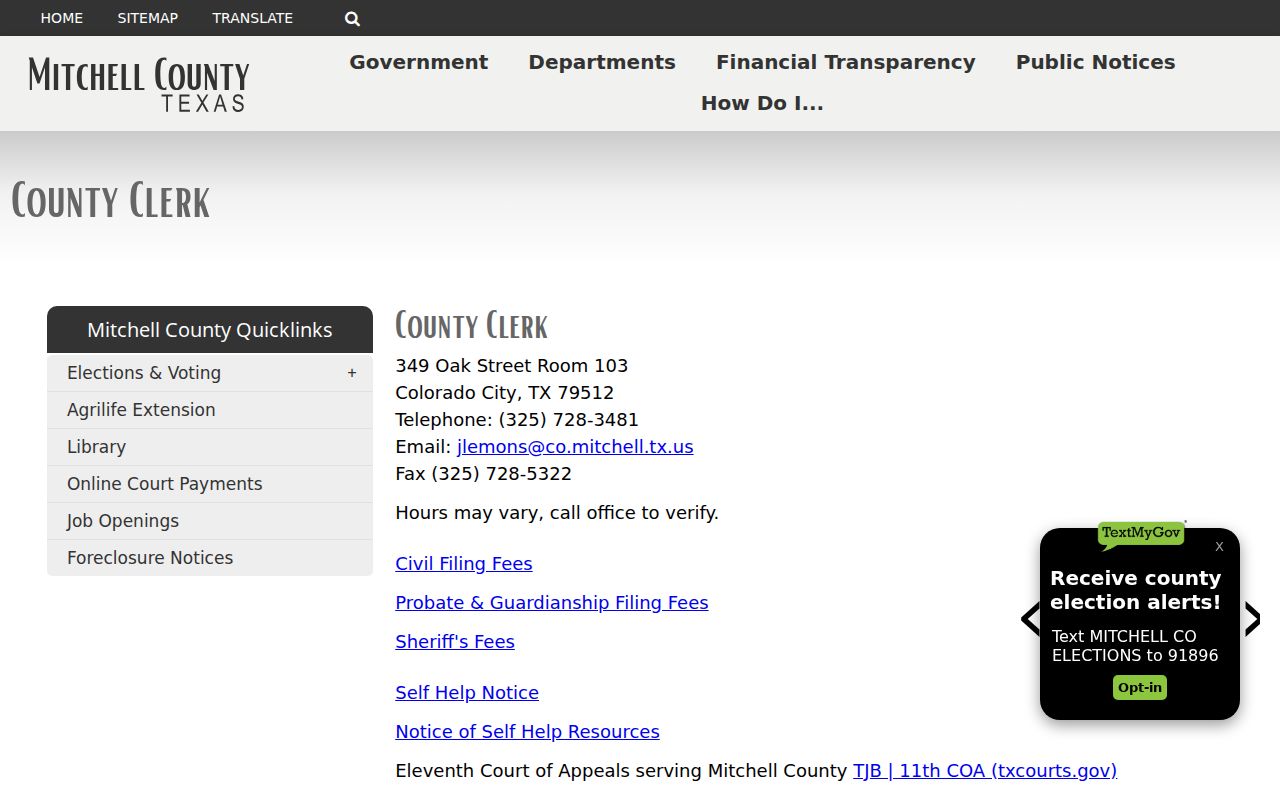
Call the County Clerk before relying on the online landing page for a Mitchell County misdemeanor search.
Mitchell County Case Record Searches
Use re:SearchTX as reconnaissance. Court participation, document coverage, registration, and charges can vary. Mitchell County does not advertise the statewide service as its own complete criminal lookup, so a result should be checked with the clerk. A missing result is not proof that no case exists.
- Search the statewide platform by a party name or known case number, then narrow by criminal category, court, location, or filing period when those controls are available.
- Decide whether the matter is a felony, a Class A or B misdemeanor, or a fine-only case. This identifies the likely custodian.
- Call the proper Mitchell County clerk with the full name, approximate filing year, and case number. Supply a date of birth only if the clerk asks for it.
- Request the docket and disposition first. Then identify the filings, order, judgment, or sentence needed for inspection or copying.
- Ask whether the file is electronic or archived, whether inspection is free, and what a plain or certified copy will cost before ordering.
| Field label | Type | Required | Use or limit |
|---|---|---|---|
| Person or organization | Text | One search route | Search alternate spellings and aliases |
| Case number | Text | One search route | Best direct identifier when known |
| Court or location | Filter | No | Narrow to Mitchell County or a named court |
| Case category | Filter | No | Select criminal where the court supplies it |
| Filing-date range | Date filter | No | Use filing date, which may differ from arrest date |
The state judiciary platform is shown below as a useful first pass. Its coverage limits make clerk confirmation part of every sound Mitchell County case search.
A portal hit can point to the file, but the originating clerk controls the authoritative docket and certified court record.
Sweetwater Is Not Mitchell's File Counter
The 32nd District Judge's administrative office is on the second floor of the Nolan County Courthouse, 100 East Third Street, Suite 204, in Sweetwater. That office handles district administration and scheduling. It is not the Mitchell County filing counter. Pleadings, docket entries, judgments, and copies for Mitchell County cases belong with the correct clerk in Colorado City.
This distinction prevents a common dead end. A setting may involve the same district judge, while the court record still remains in the county where the case was filed. Contact the judge's office at (325) 235-3133 only for appropriate scheduling or administrative questions. Direct file inspection and copy requests to Room 302 or Room 103 based on charge level.
The official District Judge page documents the separate Sweetwater address. Its image helps distinguish that office from the Mitchell County court-record counter.
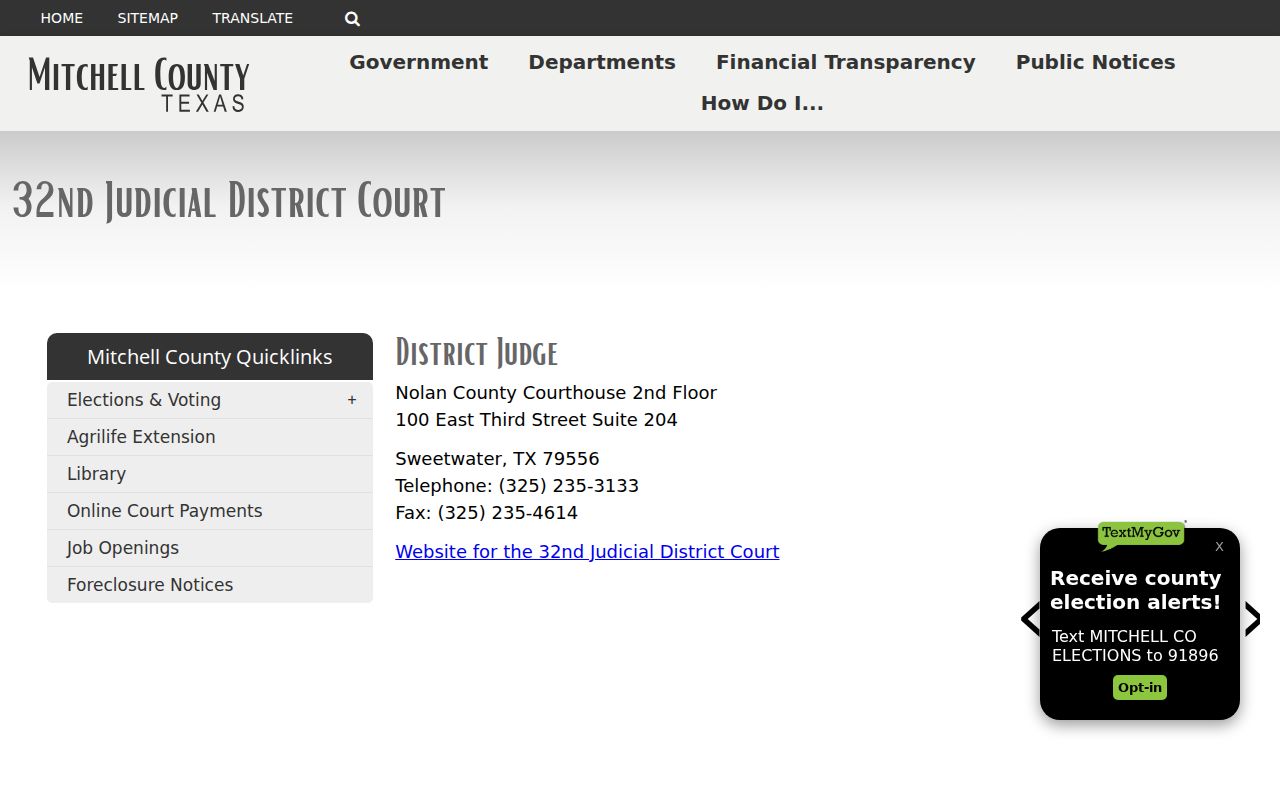
Use the office shown for district administration, while Mitchell County case files stay with the Mitchell County clerk.
What a Criminal Case File Contains
A Mitchell County criminal case file records what prosecutors filed and what the court did. The docket is the chronological index. It may lead to the complaint, information, indictment, bond papers, motions, hearing entries, plea, judgment, and sentence. Not every document image will be online. Some may be restricted or available only after a clerk retrieves the file.
| Case number and court | Identifies the specific action, custodian, and court level. |
|---|---|
| Filing date and status | Shows when the case began and whether it remains open, disposed, or on appeal. |
| Charging document | States the filed offense, statute, class, and allegations accepted for prosecution. |
| Parties and attorneys | Lists State and defendant roles plus counsel when entered. |
| Docket and settings | Tracks motions, hearings, court events, and scheduled appearances. |
| Plea and disposition | Records the formal answer and outcome, including dismissal, acquittal, deferred adjudication, or conviction. |
| Judgment and sentence | Supplies the signed result, punishment, supervision, fines, or other terms when applicable. |
Dates of birth, Social Security numbers, protected victim or minor identities, sealed papers, and confidential juvenile records should not be expected in a public view.
Mitchell County Filed Charges Explained
An arrest charge is the allegation recorded during intake. A prosecutor may decline it, replace it, or file a different offense after reviewing the report. The charging instrument in the Mitchell County court file controls what moved forward. The judgment controls the final result. Reading only the booking line can therefore give an incomplete view of the case.
- Complaint
- A sworn allegation that begins process or supports probable cause.
- Information
- A prosecutor-filed charging paper commonly used for a misdemeanor.
- Indictment
- A grand jury's formal felony accusation, also called a true bill.
- Disposition
- The court case outcome, such as dismissal, acquittal, deferred adjudication, or conviction.
- Docket
- The dated register of filings, settings, rulings, and other case events.
A dismissed charge did not produce a conviction on that count. It does not erase the earlier booking by itself. Deferred adjudication is not an ordinary judgment of conviction, yet DPS may publicly disseminate it unless a nondisclosure order applies.
Criminal Case Stages in Mitchell County
A Mitchell County prosecution can start with an arrest or summons. A magistrate addresses warnings, probable cause, counsel, and bond after an arrest. The prosecutor then chooses whether and what to file. Felony accusations may proceed to a grand jury, while misdemeanor charges commonly use an information. Arraignment receives a plea, and pretrial work addresses discovery and motions before a plea or trial.
Case flow: Charges Filed › Arraignment › Pretrial › Plea or Trial › Disposition › Sentencing
Later entries may include an appeal, supervision revocation, expunction, or nondisclosure action. The Eleventh Court of Appeals serves Mitchell County. Each later event should be read with the signed order, not inferred from a brief docket label.
Mitchell County Federal Court Records
Federal cases are not filed in the Mitchell County Courthouse. Mitchell County lies in the Northern District of Texas, Abilene Division. Search federal criminal dockets through PACER after registration, and use the federal docket number to distinguish that record from a state prosecution. PACER's stated rate is $0.10 per page with a cap for most documents, and quarterly use of $30 or less is waived under the published policy. The U.S. Attorney identifies the federal prosecution office, while the U.S. Marshals Service publishes its district role. Confirm current terms and contacts at their official sources.
The official PACER service supplies the federal document route. The captured screen below marks the boundary between federal and Mitchell County case access.
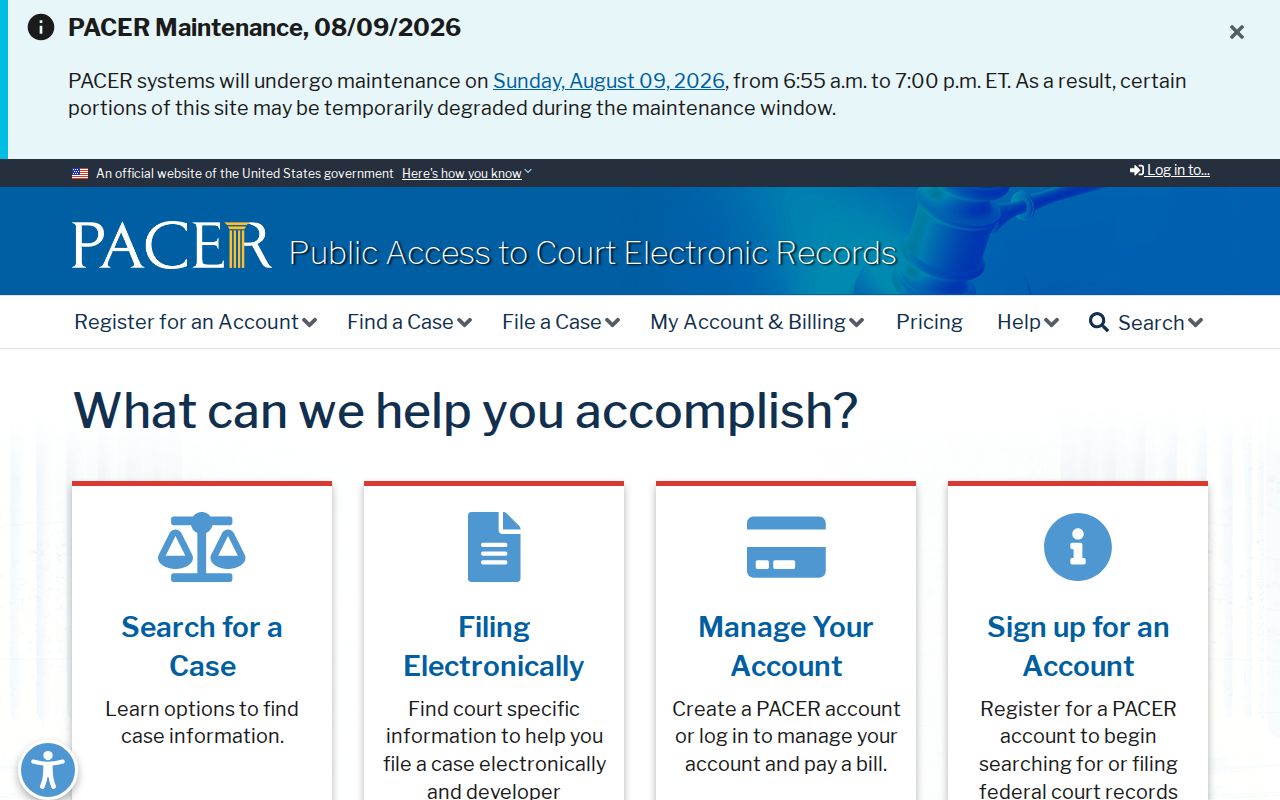
PACER does not replace Room 302, Room 103, or re:SearchTX for a Texas state case filed in Mitchell County. A subject reviewing a personal federal identity history uses the FBI Identity History Summary process and its electronic request portal, not a county docket search.
Access Rules for Case Records
Texas court records are generally open under the judiciary's rules and access framework, subject to sealing rules and laws that make certain material confidential. Judicial files do not use the same process as ordinary executive-agency records under the Texas Public Information Act. Ask the clerk about the court's inspection and copy route rather than sending a broad public-information demand for a judicial file.
Public access does not include every identifier or paper. Juvenile files, expunged records, sealed or nondisclosed material, protected victim information, and sensitive personal identifiers can be withheld or redacted. Online access can be narrower than the courthouse file. If no result appears, call the custodian and ask whether the case is archived, filed under another spelling, restricted, or outside the portal's participating coverage.
Note: Mitchell County has not published a current criminal-copy fee schedule, so request an estimate before asking for certified or archived material.
Mitchell County Case Outcomes Decoded
The last docket event is not always the final word. Read the disposition and signed judgment together. A dismissal ends the filed charge without a conviction, but the arrest and booking may remain until a court grants qualifying relief. An acquittal is a not-guilty outcome and may support expunction. A conviction includes a finding or judgment of guilt and the sentence imposed.
Deferred adjudication places a person on supervision without an immediate ordinary finding of guilt. Successful completion can lead to dismissal, though the event may remain public through DPS unless nondisclosed. Nolle prosequi means the prosecutor formally chose not to continue a charge. A no-bill means the grand jury did not approve a proposed indictment. These terms describe different paths and should not be collapsed into “cleared.”
When proof matters, obtain a certified disposition or judgment from the Mitchell County clerk that maintains the case. Compare that source paper with the statewide result. If a statewide record is wrong, the certified court document supports correction through the agency that reported or maintains the error.